

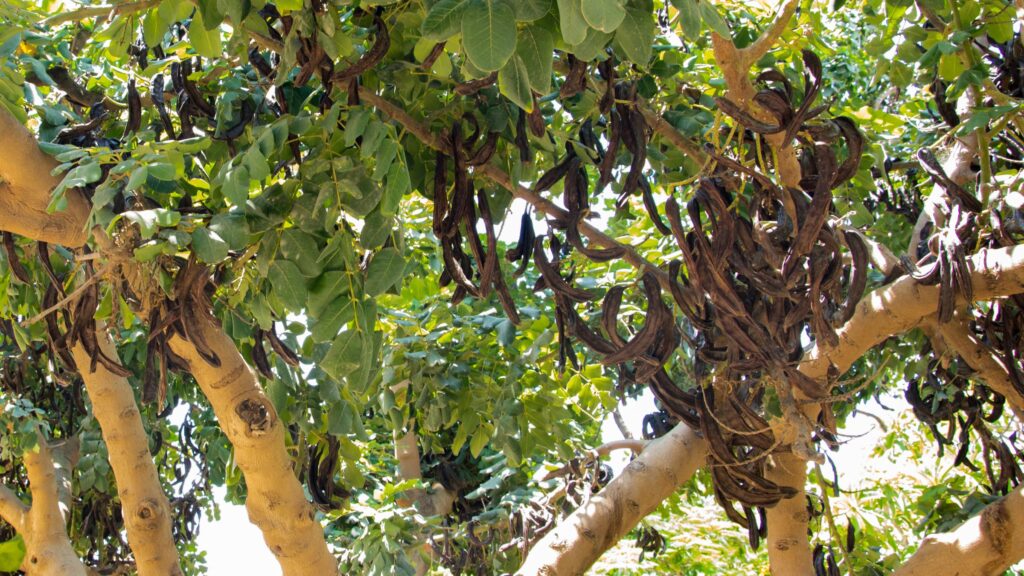
Carob has shaped the Mediterranean landscape for centuries. In the Algarve, it grows quietly between stone walls, dry fields and olive trees , resilient under strong sun, steady through long summers, rooted deep in poor soil.
On our Quinta, carob is not a trend or a commodity. It is part of the land we live on.
The trees do not demand much. They grow slowly, adapting to wind, heat and drought. Some have stood here longer than we have. They do not need irrigation systems or intensive cultivation. They follow their own rhythm, season after season.
We work with that rhythm.
Each pod is harvested by hand, tree by tree. We select carefully, taking only mature pods and respecting what the season gives us. There is no rush and no mass production. The harvest is physical, grounded work, carried out under the same sun that shaped the fruit.
After harvest, the pods are washed and hand-selected again. We gently roast them at low temperature (80–85°C for around 20 minutes). This is not to transform them, but to slightly enhance their natural sweetness and deepen their aroma. Once cooled, every batch is inspected again before being packed.
- No additives.
- No preservatives.
- No artificial flavouring.
Just carob as it grows here.
Much of what we work with comes from traditional, non-industrial landscapes. These are not large monoculture plantations. They are scattered trees, growing naturally among other native plants, shaped by soil and climate. This gives the pods their character, subtle differences from tree to tree, season to season.
Carob has long been valued across Mediterranean cultures. It has been used as food during times of scarcity, as a natural sweet ingredient, and as part of traditional rural life. Today, it remains what it has always been: a simple, honest fruit.
From our Quinta to your home, our carob carries the place it comes from.
- It grows slowly.
- It is handled carefully.
- It remains true to itself.
The Tree
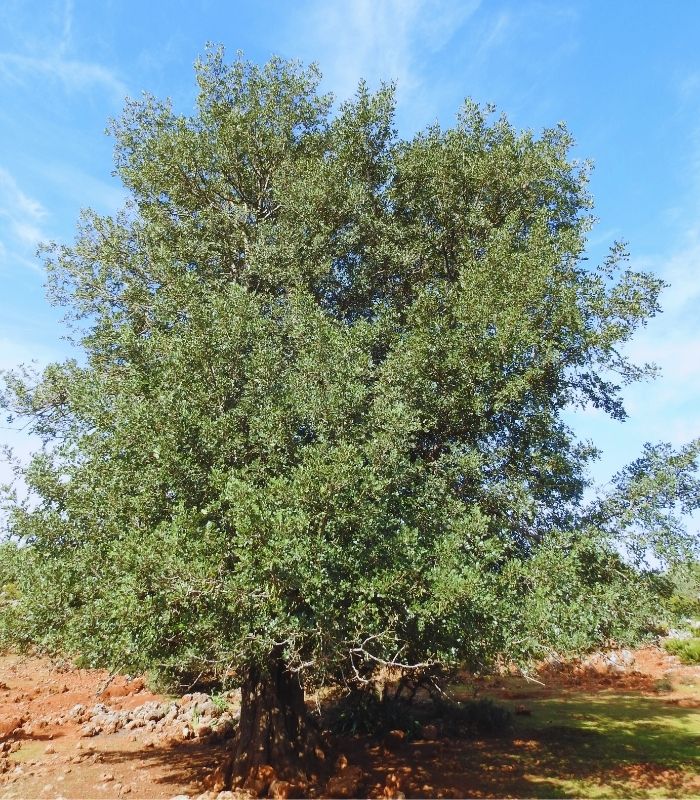
The carob tree is one of the quiet guardians of the Algarve landscape. It stands strong under the southern sun, rooted deeply in dry soil, shaped by wind, heat and time.
It does not require constant care. It does not demand fertile land or artificial irrigation. It adapts. It endures. For generations.
Some carob trees can live for more than a hundred years. They grow slowly and steadily, developing a dense canopy and a powerful root system that reaches deep into the earth. In a region where summers are long and rainfall is scarce, resilience is essential. The carob tree carries this resilience naturally.
Across southern Portugal, these trees define the rural scenery. They grow between stone walls, along dusty paths and among olive trees and wild herbs. Their presence is subtle but constant.
Carob trees follow the rhythm of the seasons. In spring, small flowers appear quietly among the leaves. Over the months, the pods begin to form and mature under the sun. By late summer, they have darkened and hardened, filled with natural sugars developed through slow exposure to heat.
This is not a fast crop. It is not engineered for speed or uniformity. Each tree develops at its own pace, influenced by soil, climate and age.
On our Quinta, the carob tree is not just a source of fruit. It is part of the land itself. It stands as a reminder that strength does not need to be loud and that quality often comes from patience.
The tree gives. We respect what it gives.
Harvest
Harvest season arrives at the end of summer, when the pods have fully matured under months of sun and dry air. Their colour deepens, their surface hardens, and their natural sweetness has developed slowly over time.
We harvest by hand.
There are no large machines moving through the fields. No industrial collection. Each tree is approached individually. The work is physical and deliberate. Mature pods are selected carefully, while unripe fruit is left behind.
This process takes time. It requires attention. It requires patience.
Carob trees do not ripen uniformly. Some branches are ready earlier, others later. Harvesting by hand allows us to respect this natural variation. We take what is ready and leave what still needs time.
The sound of pods falling onto the dry ground is part of late summer in the Algarve. The air is warm, the soil dusty, the light strong. Harvest is not rushed. It follows the rhythm of the land.
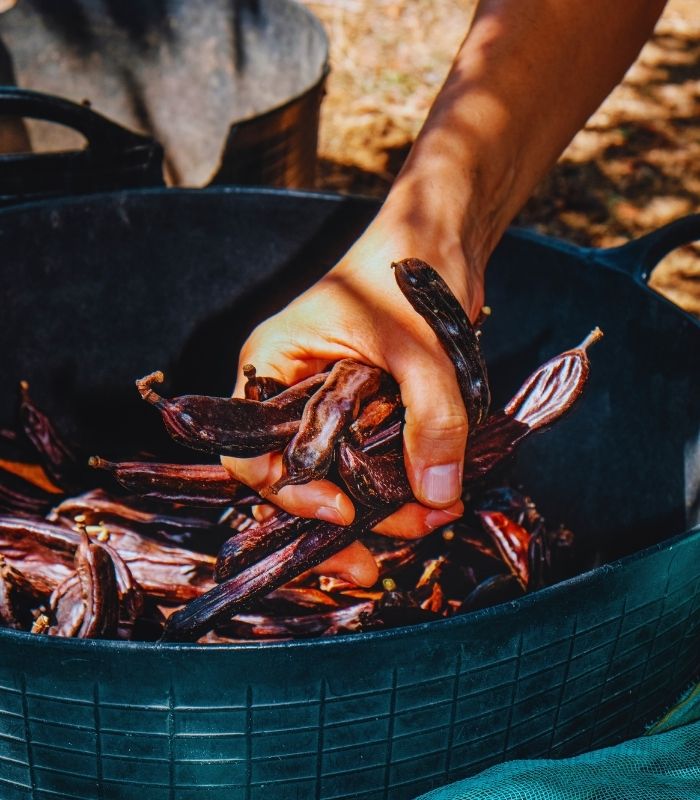
Once collected, the pods are transported directly to our preparation area on the Quinta. They are not stored for long periods or moved through multiple facilities. The transition from tree to processing remains short and controlled.
The harvest is where care begins. It is the first step in preserving the natural character of the fruit.
What the tree has developed over months cannot be replaced later. It can only be respected.
Our Process
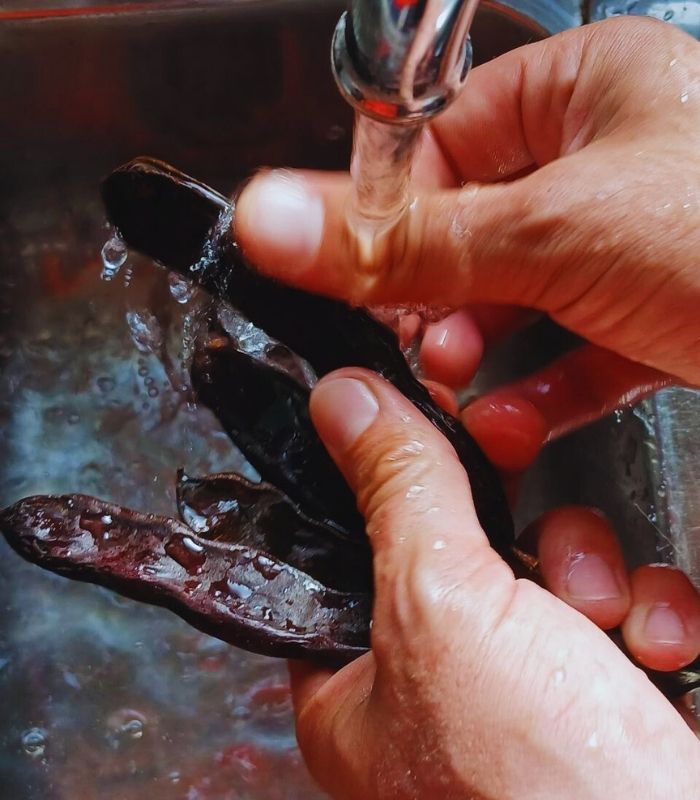
After harvest, the work continues with the same level of care.
The pods are first washed to remove dust and natural residue from the field. This step is simple, yet essential. Clean fruit allows the natural character of the carob to remain clear and pure.
Each pod is then inspected and selected by hand. Damaged or imperfect pieces are removed. What remains is carefully prepared for the next stage.
We lightly roast the carob at low temperature, between 80 and 85 degrees Celsius, for approximately twenty minutes. The purpose is not to alter the fruit, but to gently enhance what is already present. The warmth deepens the aroma and brings forward the natural sweetness that developed slowly on the tree.
The roasting remains controlled and moderate. Excessive heat would mask the character of the fruit. We prefer subtlety.
After roasting, the pods are allowed to cool naturally. Once cooled, they are inspected again before being packed. This final selection ensures that only carefully prepared carob reaches the pouch.
The entire process takes place on our Quinta. There are no external processing facilities, no complex industrial steps, and no unnecessary interventions.
- No additives are introduced.
- No preservatives are used.
- No artificial flavouring is added.
Our role is not to transform the fruit into something different. Our role is to prepare it carefully and preserve what nature has already created.
- Simple methods.
- Controlled temperatures.
- Patient handling.
From tree to pouch, the process remains transparent and close to its origin.
Why Carob
Carob has been valued across Mediterranean cultures for centuries. Long before modern food systems existed, it was part of everyday life in southern regions. It was stored, shared, and used in simple, nourishing ways.
Its appeal lies in its natural balance.
Carob develops sweetness slowly on the tree. The long exposure to sun and dry climate allows natural sugars to form gradually, without refinement or processing. This gives the fruit its mild, rounded taste.
Unlike many modern ingredients, carob does not rely on artificial enhancement. It carries its own character. Earthy, subtly sweet, and warm in aroma.
Traditionally, carob has been used as a natural sweet ingredient, as a snack, or as part of simple rural diets. In times when resources were limited, it provided energy and nourishment. It became known as a reliable and humble fruit, growing where little else would thrive.
Today, carob is appreciated again for what it has always been. A naturally sweet fruit. A simple ingredient. A product of climate, soil and time.
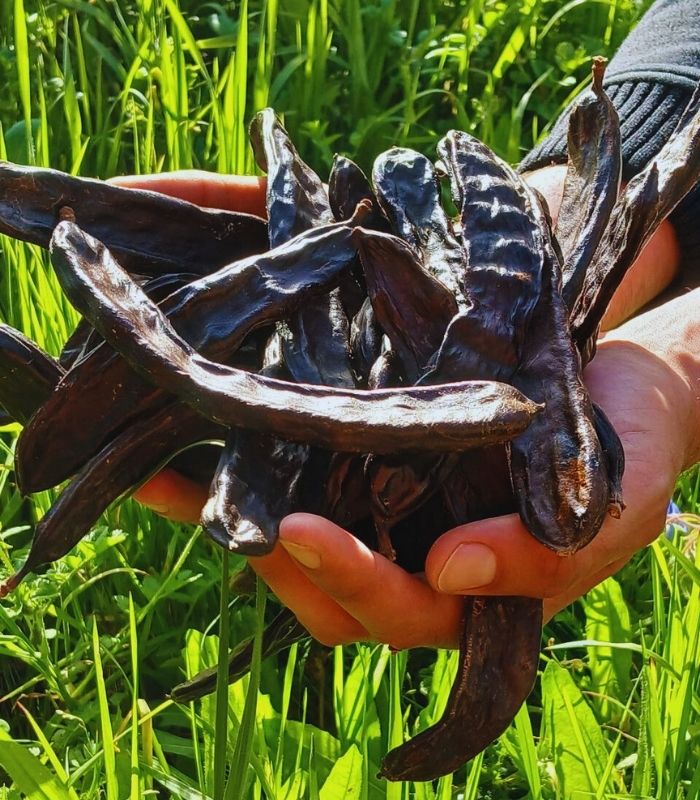
We choose carob because it represents resilience and simplicity. It grows without excess intervention. It fits the rhythm of the Algarve. It connects present work with long-standing tradition.
- Carob does not need reinvention.
- It only needs respect.


